Monday, 10 July 2017

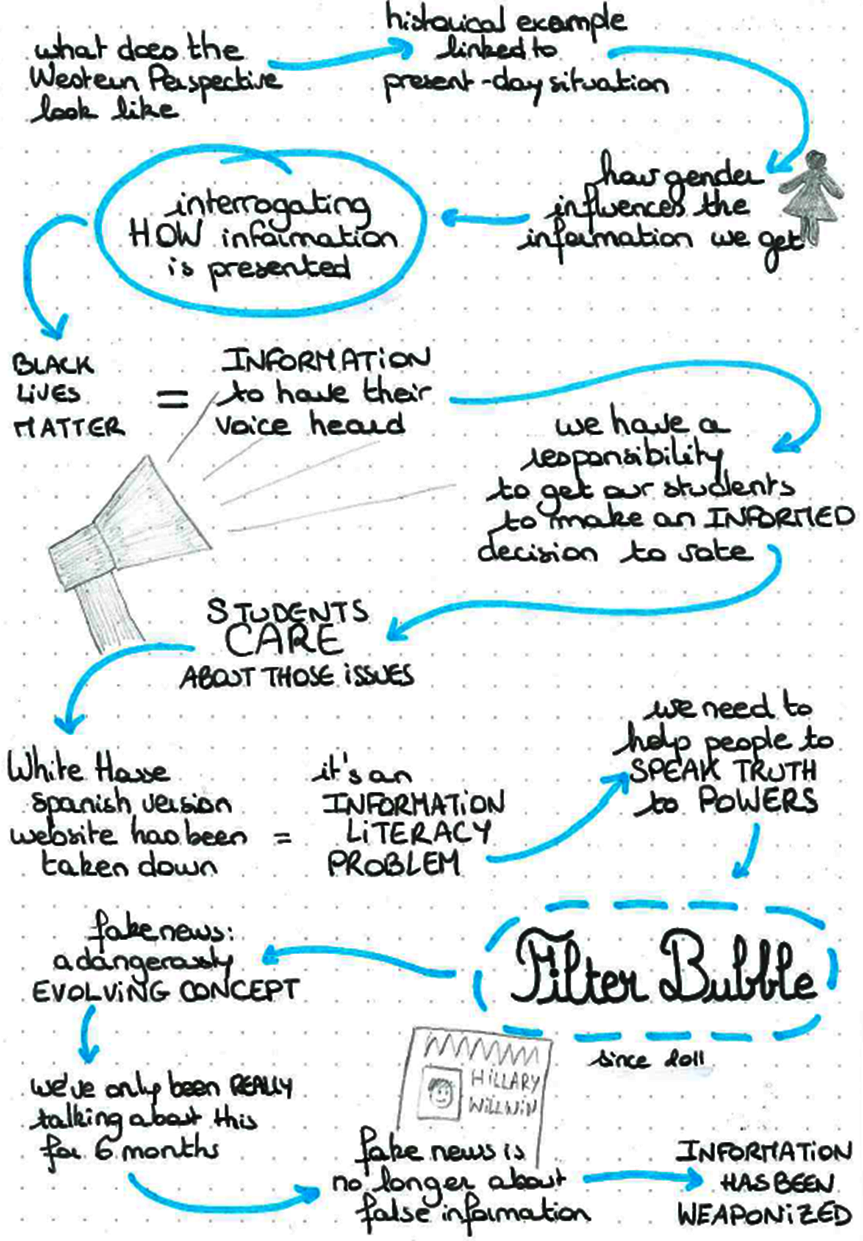
Sketchnotes from #LILAC17


I've been meaning to post this for a few months now but I seemed to never have time... I finally do now!

I was very happy to return to LILAC this year and honoured to be able to do so thanks to a bursary. Leanne Workman interviewed all bursary winners and you can find her article here.

It was amazing to be once again in this bursting explosion of ideas that is LILAC and I went home with a buzzing head full of exciting leads to follow.

As last year, I made sketchnotes of the presentations I attended and shared them on Instagram / Twitter.
Here they are finally in blog form - I hope you find them interesting!

Keynote by Josie Fraser – Librarians and Information Professionals as Open Practitioners


Video available here - Slides available here


Critical Reading Made Easy, Pip Divall

Slides available here.


Students as positive disruptors, Vicky Grant, Kate Grisby, Sophie Carlson, Rosa Sadler

Slides available here.


You don’t know what you don’t know, Shirley Yearwood-Jackman

Slides available here.


Keynote by Barbara Allan – Making an impact beyond the library and information service

Video available here.


Getting bums on virtual seats, Katherine Moore and Nicola Beer from the Open University

Slides available here.


Academic integrity and doctoral education, Lene Østvand and Helene Andreassen

Slides available here.


Practitioner research for librarians, Adama Edwards and Vanessa Hill

Slides available here.


And the winner is… Samantha Brown and Abigail Heath

Slides available here.


Keynote by Alan Carbery – Authentic Information Literacy in an era of Post Truth

Video available here - Slides available here.


Flipped classroom intervention, Torstein Låg

Slides available here.


Final words by Jane Secker and Nick Poole – The Future of Information Literacy


Tuesday, 28 June 2016

#ARLG16: Teaching electronic resources to students with computer anxiety

I'm just back from a short trip to Birmingham where I had the chance to do a workshop at the ARLG conference on my theme of predilection: teaching electronic resources to students with computer anxiety.

If you want to have a look at my presentation, here it is:


For a more detailed version, you can have a look at my -quite similar- presentation from LILAC. The main difference here was that we actually tried out some of the activities I proposed.

The participants kindly went along with my activities and completed some worksheets about the main problems they face with computer anxious students. If you want to have a look at what they came up with, have a look over here.

Finally, I put together a very complete handout including most of what I said out loud as well as many of the materials I actually use with my students (so you can use them too!).
You can download it over here.

Hoping you'll find all of those documents useful!


Monday, 23 May 2016

How to start sketchnoting


This article is a translation from Magalie Le Gall's article, published in French over here. Magalie is a French librarian in Paris, fan of Lego and visual mapping. (And she's awesome.)
Reading her article some time ago made me fall instantly for skechnoting... as you may have noticed from my recent notes from LILAC.
So I wanted to share her article with you, hoping that it will inspire you to try it out too!


On 25-26th January, I went to the workshop I had gifted myself for Christmas: the #visualmapping workshop by Philippe Boukobza (from the excellent blog Heuristiquement - in French) near Paris.

Besides madly hearting this workshop and intending to continue until I get certified, I have resolved sketchnoting my meetings, trainings, or study day reports. Anything coming my way, actually.

Why?

Because (I know you think so too) a report is usually effing boring. So there are good chances you won't ever [re-]read it again. And if you forward your pretty 15 pages long, 11 font-size Word document to your colleagues... ? In short, a lot of work for very little results.

Sketch... what?

Philippe Boukobza defines it this way: "Sketchnoting means translating concepts, process, ideas, conversations in visual thoughts, individually and as a note-taking technique." By putting forward keywords, expressions, relationships and pictograms, you have to not only really understand the content you're transcribing, but also simplify it as much as you can. Down with parasitic sentences that weigh your reports down!


Let's tackle the "drawing" issue

After talking about it with lots of people, I know we're touching a sensitive point. Seeing my sketchnotes, many colleagues or friends exclaimed "oh you're gifted, that's obvious, there's nothing crossed out, and you're a creative person. I wouldn't be able to do this, my writing's a mess and I don't know how to draw". I can tell you that this makes me mad. Like, for real.

I'm just a clumsy oaf as far as art drawing goes. It's true that I like for it to be neat, but I really don't care if it's "pretty" or not, I'm just having fun. And since we're on the topic, let me underline that a sketchnote is not destined to be pretty: it is destined to be understood, [re-]read and memorised.

Let's get back to drawing: we're all able to draw! I bet that when you were little you didn't even ask yourself the question. Paper, pens and hop! You were gone. You even did it for hours. Unfortunately school, negative judgements from others, the framework imposed by work, all these things had their effect. And that's just as true for sports, music, languages, maths, writing... You're amongst the gifted ones or you're not. And if you're not, then you're absolutely not touching it ever again. So it's not so much our ability to do this or that that is the problem, but the trust you have in your ability to do it. You're self-limiting yourselves, here, I said it.

Now, take a sheet of paper, a pen, and have a look at the following video:


See! You can draw too!


But it must take ages!

No more than typing up a report, re-reading it to complete it and tweak the layout. Of course, you need to take new habits and admit that you won't write everything down, instead only keeping key concepts from what's going to be said. That's also why your typography and pictograms need to be simple to do.

Let's try it out (yay!)

  • Just as Graham Shaw says in his video, you need to be open minded: let go from expectations, don't think about the results. Remember what Zohra Kaafar wrote in one of her presentations: "creativity is contagious, make it go round."
  • Do know that, the first time, your colleagues are probably going to watch you with a weird look on their face (but they'll soon be very interested!).
  • To start easy, you can sketchnote very short meetings or just your train of thoughts for a project or a training session you're going to give... [tip from Aurélie: you can also go online and sketchnote a TED talk, a MOOC lesson, or even a podcast - and remember: there's nothing at stakes and nobody needs to see it... just have fun!]

Sketchnoting, how does it work?

  • In order to represent visually an idea or an abstract concept, think of shapes (square, circle, rectangle...) or of the image it makes you think of. Here are a few examples:

  • Use arrows, banners, different typographic styles in order to push the main ideas forward. Visually, it changes everything. And it's really easy to do!
(source) [tip from Aurélie: I've printed this reminder and glued it at the end of my notebook... so useful when you're trying to think of a different bullet point idea in the middle of a sketchnote!]

  • Make sure you have a good balance between pictograms and keywords: your sketchnote needs to still be understandable several weeks / months later.
  • In one of his articles (French link), Philippe Boukobza reminds us of the main principles for a good sketchnote: use space to let the note breathe, accentuate keywords by playing with typography, insert very simple illustrations to strengthen the message and, finally, stay simple as far as colours go.
  • And, let me repeat this to make sure you got the message: don't try and make something "beautiful" and compete with Leonardo da Vinci. For example, I like to say that I'm "scribbling" my meeting report. That helps getting rid of inhibitions.


Advice regarding stationery...

(NB: I'm going to let you know what I'm using but any kind of paper / pens would do the trick. Personally, I think that the quality of the tool and the pleasure you get from using it are important, but it's really up to you.)
  • Being a Moleskin addict, I recommend their sketch album, their new collection of Volant journal, or their digital covers compatible with tablet covers. Whichever brand you choose, make sure to get a notebook with blank pages (or with a dot grid that will help you calibrate your outline).
  • Work on only one side of the page (in portrait or landscape - doesn't matter).
  • In order to play more easily with the width of lines, you can use black pens having tips from 0.05 (very fine, perfect for the face of your little people) to 0.8 (very wide, perfect for separations, banners, or arrows). Personally, I like Staedtlers pens very much, or Micron pens.
  • For finishing touches, you can shade your drawings. Ideally, use a brush pen in a lighter colour (I'm using Pitt Faber-Castel pens in blue or grey shades. You also have the ArtMaker from Neulands which are just crazy good. 

You want to sketchnote form your tablet / smartphone?

Download the free (in its lite version) app Sketchbook Pro. Having tested it, I do recommend to use a smartpen if you want to sketchnote a full report, that's much more practical than with your finger.

And lastly I'm recommending THE book on sketchnoting: The Sketchnote Handbook by Mike Rohde. He's a specialist on the topic and also the author of a workbook (with more advanced techniques) as well as a series of videos.

(yeah, the lego book has nothing to do with it, it's just that it came in at the same time as the other two...)

I hope I've got you to want to try it out!
If you do, let us know and post your own creations online!


Friday, 1 April 2016

Sketchnoting my way through #lilac16

I enjoyed Lilac way more than I should admit; it was such a blast!
I got lucky to have my own session out of the way quite quickly so I was set free from worry early on.
Lots of lovely people came up to talk with me - which is really perfect when your introverted self has a hard time going towards people you don't know. I'm very grateful to everybody who came by and said hi!
But aside from the social side, I also enjoyed all of the talks I went to wholeheartedly.

Reflection 


So, let's reflect a little on the actual content of the conference.
(That's a lot of text down there, but if you scroll down a bit you'll find pictures!)
  • I loved learning about teaching students how to create better research topics. That's not something I've taught before, but now I really want to pitch it to the tutors I'm working with!
    • Anne-Marie Deitering explained that if students seem to be lacking curiosity in their choice of topics, it's because they tend to go for the "safe" option. It's hard to be adventurous when what you do is going to determine your grades!
    • Mason Brown came up with a great program to teach pre-freshmen how to ask good questions, and it's all based on panels from comics. It's such a great idea and he seems to have had a lot of success! I would love to try it out on my students...
  • Innovative systems for iSkills programs:
    • Librarians from the University of Liverpool came up with an innovative way to organise all the different workshops that were being proposed throughout the university: by managing it as if it was a start-up.
    • The IDEA model demonstrates how to merge instructional design with information literacy to create bespoke iSkills training for a specific course.
      1. Librarians tend to create games that teach mechanics or test knowledge. But it's actually better to just use game mechanics to frame your normal content. It was great to see how Catherine Fahey and Marcela Y. Isuster have successfully been doing it for a pre-freshman course.
      2. Using the actual standards of the profession your students are going to integrate is a great way to drive home the point that information literacy is for life, not just for university. And that they will be expected to use the skills you're teaching them during their professional lives.
    • Avoiding to do the same thing over and over... 
    • Training other professionals

    My Notes


    A foreword before the actual notes:

    I've always loved taking non-linear notes... But the week before Lilac, I learned about a technique called Sketchnoting, and decided to try and use it throughout the conference. 

    I'll tell you more about how it works next week... But for now, I just wanted to warn you that my notes look a little different that what you're probably used to. And they're not typed up. But I hope you enjoy them anyway!


    21/03/2016 – Publication without tears: tips for aspiring authors, by Emma Coonan, editor-in-chief of the Journal of Information Literacy. Link to abstract.


    21/03/2016 – Peer Support for the Development of Information and Digital Literacy Skills at the Institute of Technology Tallaght, by Philip Russell and Dr Gerard Ryder. Link to abstract.


    21/03/2016 – Copyright Literacy in the UK: tackling anxiety through learning and games, by Jane Secker and Chris Morrison. Link to abstract.


    22/03/2016 – Playing for Keeps: Game Design and Implementation for Long-Term Learning, by Catherine Fahey and Marcela Y. Isuster. Link to abstract.


    22/03/2016 – Keynote by James Clay


    22/03/2016 – Great IDEA: An Instructional Design model for Integrating Information literacy, by Kimberly Mullins. Link to abstract.


    22/03/2016 – Masters of the UniVerse! By Holly Singleton and Phil Jones. Link to abstract.


    22/03/2016 – Does the research paper kill curiosity? Collaborating with faculty to support learning and exploration, by Anne-Marie Deitering. Link to abstract.


    22/03/2016 – All you need to startup is KnowHow: creating a scalable information literacy programme at the University of Liverpool, by Nicola Kerr and Zelda Chatten. Link to Abstract.


    23/03/2016 – Is it a bird? Is it a plane? What can students learn asking questions about comics? By Mason Brown. Link to abstract.


    23/03/2016 – Using professional standards to inform information literacy work, by David Bedford. Link to abstract.


    Thursday, 24 March 2016

    #lilac16: Teaching electronic resources to students with computer anxiety

    Lilac went by so fast... and it's already over!

    On Monday, I presented a short paper to an impressively packed classroom...

    Picture by Heather Dalal.

    As promised, here is my presentation, with added notes so that you get what I was talking about...


    Note that lots of the active learning activities I mention come directly (or after modification) from this book (aka: the Bible).

    I will try and post "how-tos" for some of the activities I adapted on this blog later on.

    In the next few days, I will also post my notes from talks I attended... Stay tuned!


    Friday, 18 March 2016

    #Lilac16: preparing for it!

    Let's revive this blog from its slumber...

    Just a short word to say that I'm very much looking forward to going to #lilac16 next week.

    I've been preparing the best I can: being an introvert at a conference is not always easy!

    So far I have:
    • Booked a hotel room near the conference venue so that I can retreat for quiet times if need be. 
    • Printed all of my itineraries, plane tickets, coach tickets, hotel bookings... And also saved everything on Google Drive...
    • Studied the program and booked the talks I want to go to.
    • Tweeted to all the presenters of those talks to say hi. 
    • Looked up some "escape routes": if I go to the networking event / conference dinner, I need the reassurance of being able to leave without having to wait for the official coach back. Big events like that are always very stressful for my little introvert heart!
    • I also printed some little handouts with most of the content of my talk + references, just in case anybody wants one (come and ask me!).
    • And finally, I followed this useful webinar on getting the most out of the conference (and practiced my sketchnoting at the same time...)

    Are you going too?
    How have you prepared so far?
    Let's meet!

    Wednesday, 3 December 2014

    Inter-library loans - a French fairy tale


    Here is the post I had submitted for the CILIP Blogger Challenge. If you haven't yet, you should go and have a look at the highly commended entries, they're really great!


    [EDIT:] If you want to go further, here is a page in English about Sudoc by Émilie Liard (who I mention further down this post). And here is the page (in French) where she links to all her posts on the subject (she published a couple new posts since I wrote this article).


    I’d like to tell you a story. It involves a charming prince, a troublesome monster and an army of determined villagers. It's also about inter-library loans.

    Our story begins in France. As a French librarian, I'm well placed to tell you that libraries there are rarely praised for anything. We look over in awe at the UK’s 24/7 opening hours in university libraries, your idea stores and how you’re ready to fight to keep libraries open despite budget cuts. But I also think there might be a thing or two you could learn from how things are done on the other side of the Channel.

    When I started my first library job in London, I was shocked to discover that librarians here weren't participating in a shared catalogue with other HE libraries – something I’d taken for granted while working in France. So how, I asked, do you fulfil inter-library loans? Well, "inter-library loan" often seems to be a synonym for "asking the British Library if they have it". I learned about SCONUL and its access scheme, and about getting records for documents from other sources. But, to me, it still felt like something was missing.

    Nostalgia overwhelmed me, and I began thinking of le Sudoc...


    CHAPTER 1 – PRINCE OF CATALOGUES


    Once upon a time, in 1994, on the sunny shores of the Mediterranean Sea, in the lovely town of Montpellier, was born l'ABES.

    This elegant acronym stands for Agence Bibliographique de l'Enseignement Supérieur, France’s bibliographical agency for higher education. Its first aim was to create Sudoc, Système Universitaire de Documentation (universities system for documentation), which it did in 2001, after a seven years of incubation.

    Le Sudoc grew up fast. It's become a giant of a catalogue, to which over 1400 higher education and research libraries contribute. Today, it hosts over ten million records of documents, with their exact location (down to the shelfmark) all over France. Its OPAC is easily searchable, and there’s a mobile version proposed too. Through its network of libraries, users from everywhere can access a fully integrated system for inter-library loans, which is called PEB (for Prêt Entre Bibliothèques) in French.

    Also, having this huge shared catalogue allows HE librarians to spend a lot less time cataloguing: on a good day, this means checking that your document already exists in the database, that the record contains no mistakes and then just adding a mention at the bottom basically meaning "we have it too!".

    It's an amazing tool and treasured by students, researchers and librarians alike.


    CHAPTER 2 – BEAST OF BURDEN


    But le Sudoc has a dark side. Behind the princely, charming exterior, lurks a fanged beast from a bygone age, ready to thwart many a noble quest.

    Its main problem is its back end, which is not quite as handsome as its friendly user interface.

    The database is accessed through a software right out of the 90s, called WinIBW (or, once you're acquainted with it and it’s just died in the middle of a two-page long record losing the information forever, you're more likely to call it "Putain de Bordel de Winnie de Merde!" – a phrase that’s a little too indelicate to translate here).

    You can have a look at its interface here to get an idea: https://www.youtube.com/watch?v=xWIS-1855kc


    WinIBW is ancient. It's unintuitive and crawling with bugs too.

    One of my favourites is "le bug de la ligne 16", which occurs because, in an earlier version, lists used to appear in pages of 16 items. So now, once in a while, when you click on an item past line 16, it will display the record corresponding to the one on line 16. Charmingly eccentric, perhaps. But it quickly becomes tiresome.

    The records are displayed in UNIMARC, a 1977 version of MARC mostly used in France. The data capture area is basically a blank screen where you can write your record entirely by hand. Not super-helpful when you're new to cataloguing. It's been made slightly better by the creation of helpful macros that will automatically add the fields most often used for the type of document you're creating. But if the field you need doesn't appear, you're on your own.


    If, as I explained above, le Sudoc has made it quick and easy to catalogue new, commonly used documents, it loses all its advantages when you have to retro-catalogue older items. Yes, some of your 19th century books might have been catalogued already by someone else, but for most of them, you're going to have to create your record from scratch, taking your chances with the temperamental WinIBW interface.

    Also, as is bound to happen when you've got thousands of people working on one common tool, there are lots of duplicates. Once in a while, campaigns are led to remove them, but a week doesn't pass when you have to send messages to other libraries asking them to check if they're sure that their new record isn't really a duplicate of an existing one. And you can expect to receive your fair share of the same kind of requests, of course.


    Finally, not everything's rosy on the users' end either. To get a loan, you must be affiliated to a library. The book you ask for will arrive to the library, not on your doorstep. And it can take quite some time to arrive, since there's usually only one ILL officer per library, to take care of all the requests and scan them or send them by post. And it can be a laborious task. ILL officers have to keep up with the loans by hand, and since it's a library-to-library service with no direct contact with the end user, sending reminders for late documents can be a challenge. Perhaps inevitably, there’s unrest…


    CHAPTER 3 – PITCHFORKS AT THE READY?


    For years, the library villagers lived with le Sudoc’s half-prince, half-beast nature. They nurtured it the best they could. But back in their homes, in the dead of night, they would talk. Had the time come to slay the beast within? Or could it be tamed?

    Has the story so far convinced you of how impractical and complicated this all is? Have you pictured thousands of French librarians pulling their hair out in despair after falling victim to another of Winnie’s bugs? Do you wonder why they haven’t tried to escape??

    Well, the answer is, I think, there’s an element of Stockholm Syndrome. We wail and whine and despair, but we go back to the task. We find the ancient interface "charming" and "vintage" – in many ways, we truly are captivated. We often just laugh sadly when the next bug strikes. The adversities of the system have actually brought us together in a community of traumatised cataloguers.


    In French university libraries, when you arrive on your first cataloguing job, you're sent on a three-and-a-half-day course to be introduced to the great Winnie. You come back, now an official member of the WinIBW's cult, with a folder full of documentation and a new mantra: "F1 for help". From now on, you're going to hit the F1 key approximately every five minutes to get to the online help and check all the crucial information on the various UNIMARC fields and subfields that’s missing from the software.

    If F1 is not enough, you can then ask on the (also ancient, but still very active) "Sucat" mailing-list. But even better than this, is the Twitter community of French librarians. Over the years, I’ve submitted dozens of weird cataloguing questions and got an immediate answer almost every time. We also got into the habit of live tweeting some of our cataloguing sessions. This is a great way to share professional practices and stimulate discussion on some particular cataloguing points.

    Tweeting librarians are also very often blogging librarians, and they like to share their tips and tools. For example, Pierre Marige created an online tool to check some key points of new records and shared it on his blog. There’s also Emilie Liard, who, earlier this year, stirred up ideas for how to improve WinIBW in one of her blog posts. She then submitted the suggestions to the ABES group she works with, which is now thinking about what to do next.


    So will there be a happily ever after? WinIBW won't be around forever, but le Sudoc hopefully will, and it will get bigger and better. The French library folk are stuck with their charming beast for now, and will treat it with as much patience and good humour as can be mustered.

    Of course, the scythes and pitchforks are kept nearby just in case, but the day to use them hasn't arrived yet. And they know that if they keep talking, keep working, they’ll be stronger for sticking together. The le Sudoc story is far from over and I can’t wait to see what the next chapter will bring...


    This blogpost has been kindly edited by the fantastic Anthony Farthing.


    Creative Commons License
    The above picture is by Pier-Luc Bergeron. It is licensed under a Creative Commons Attribution-ShareAlike 2.0 Generic License.

    Wednesday, 26 November 2014

    Rebus: Tutorial - Creating online tutorials for you own resources

    Earlier this month, I went to a Lib Tech Meet at Cilip's. An array of different people did three or seven minutes presentations on topics relating to the use of technology in libraries.

    So here is the three minutes presentation I did (slightly re-arranged for Web use - the initial one had much less words on it!).


    If you want to have a look at Guides on the side, here they are.
    And here is where you can get more info on Rebus: Tutorial.

    Monday, 27 October 2014

    Identity, gender and libraries

    Today, my French blog turns 3 years old! To celebrate, I decided to translate one of my most popular (and personal favourite) blogpost (original version here). I wrote it after attending my first ever librarian conference at Paris Book Fair in 2012.
    Two and a half years later, I own up my librarian identity with more strength, but I'm still churned up by all those questions...


    I didn't count how many of us were there, that Monday, pressed against each other to be reassured by our governing body on the future of our profession. So, I didn't count, but it was absolutely obvious. There were only women. Well, there was a handful of men, including two on stage, but the feminine mass was unbearable. And I felt a powerful uneasiness yelling in my head that I wasn't supposed to be here. I should have known, though. I know the numbers. But it was the very first time that I was witnessing an actual librarian gathering, and I was shocked.

    I'm really annoyed to admit it, but I'm deeply ashamed to have a girl's job. It might go back to my science studies during which, each year, the proportion of female students diminished. I felt at home amongst my male peers, I was happy to be on my way to a man's job (I don't have any numbers, but let me assure you that Earth sciences researchers are mostly male), to show them all, to corrupt the system, to indulge my pride. But I finally understood that muddy outdoors research wasn't for me and a part-time job as a library assistant led me to Higher Education libraries.

    Higher Education, that wasn't that bad. Research libraries were even better. Anything not to become a "kid's librarian". I'm not maternal, I'm not girly, I don't like pink. I don't identify with female professions, and children librarian seems to be in the top three of girls' jobs, amongst kindergarten teacher and nurse. And housewife. So, when I got a new job in Higher Education and was asked to take on the "youth literature" collection, it hit me hard.

    But why? That's so stupid! I'm ashamed of a job I love! I'm ashamed when I think of turning towards public libraries so as to move back to my mountains more easily. Ah! I was good in school, I should have gone for a man's job, opening the way, thwarting the glass ceiling, rather than going for lower female tasks! I'm ashamed, when I introduce myself, to say what my job is. It sounds like a failure. I'm "only" a librarian. So, very fast, I add: I work for a university! I work with students and professors! I'm not that librarian, the one who reads to inattentive classes, who shush children from behind her desk! No, that's not me! No! No?

    But why do I have, engraved in my brain, all of those idiotic prejudices? I do rationally know that public librarian is a great and indispensable job, made of communication and popularisation, and I'm sure I'd love to do it, to make it mine. It actually was one of my ambitions, when I began thinking about going towards information sciences: how great would it be to popularise the sciences I love so dearly in a public library! How I would like to promote reading and culture in my town!

    So why are those sexist pictures pinned on the walls of my brain? Why "youth librarian" stays a female noun in our mental dictionaries? Where are the men? Show them to me! They should give themselves up! They should promote themselves! They should tell us of their joy and pride to do this wonderful "girl's" job in those numerous public libraries around the country! They should reinvest those professions from which they had withdrawn, taking with them the value, the prestige, the big names and the high salaries. Let us have some real equality, a world where caring or meticulous jobs are really welcoming all genders, where little boys can look after dolls and dress in pink without being pointed out by the rest of their community.

    In the end, I feel guilty to think that much about it. As Caitlin Moran, I'm asking: "are the boys doing it?". Are the boys worried about the gender balance of their professions, do they spend hours banging their heads against walls to try and decide if, by choosing the job they chose, the lifestyle they live, the shoes they wear, they aren't deserting their gender, they aren't letting their comrades down? No, do they seem to say, too preoccupied behind their computers, behind rows of cots, behind the wheel of their lorry, crouching in front of the 305.42, looking for a missing book.
    "Then, we can use the technical term, and call it bullshit."
    They don't care. So we shouldn't care either. And move forward, rather that staying there pondering over and over. Let's just hope that our daughters may never feel this stupid failure feeling when choosing a job that is neither male nor female. Just a human's job. And, what's more, a really cool one.


    Licence Creative CommonsPicture taken myself at the Père Lachaise, Paris, in March 2012.
    Both text and pictures are licensed under a Creative Commons Attribution-NonCommercial-NoDerivs 2.0 Generic License.

    Thursday, 16 October 2014

    Stationery Love

    At first I read Library Goddess's post on "The Power of the Post-It", then came Twinset & Purls' one about her notebooks, and the sparked conversation on Twitter, #stationerylove.
    So, really, I couldn't resist.
    I've written a little post about my organisational tools on my French blog, last August, but didn't translate it for one reason or another. So, maybe the time has come to tell you here about my notebook compulsions...

    I've been on the lookout for the perfect organisational tools for quite a while. It's quite an obsession really. I like to be on top of things, and that means that I need to always remember what, when and how... From a medical appointment to my writing projects or the training sessions I'm giving at work. I don't feel good if everything's not under control.
    So I've tried a lot of online stuff, like automated to-do lists or specific apps... But, as much as I like a good spreadsheet, for my day to day mess, that's not working for me. The only digital thing I've stuck with is Google Agenda. It's the first thing I look at on my phone or when I open my computer, even before my emails or Twitter notifications...
    But for all the rest, I'm a paper girl.

    Notebooks

    A long time ago, I decided to use only one journal for both my personal and professional stuff. I tried to have two different ones but I really prefer being able to write down everything in one place: if ideas for my grocery list come up in the middle of the day, it goes in my journal. If I remember an activity I wanted to try with a group of students in the middle of the night, it goes in my journal. Everything goes in the same place, so it's a bit of a mess, but at least I'm sure to have everything on hand.

    My current journal, decorated by my lovely sister, Julia.

    Why a paper notebook? Well, first because it's pretty. (Yes, it counts. A lot.)
    And because it enables me to draw a little, to create mind maps and even to some art journaling when I feel like it, without having to try to find and learn to use the best software for whatever I want to create.
    Also because I love writing by hand. I think better when I'm writing. Moreover, I write a lot during my commute and, you can say whatever you'd like, typing on a virtual keyboard isn't the most practical thing ever.
    Finally, I'm a much faster note taker when I jot them by hand during conferences and workshops. Because I love abbreviations and big arrows that go all over the place. So I tend to think that it's worth it to have to type it all up when I come back from a study day. And that's always good to get some order back into the sometimes sibylline presentation structures of some speakers...

    A bit of mind-mapping in an old journal.

    To-Do Lists

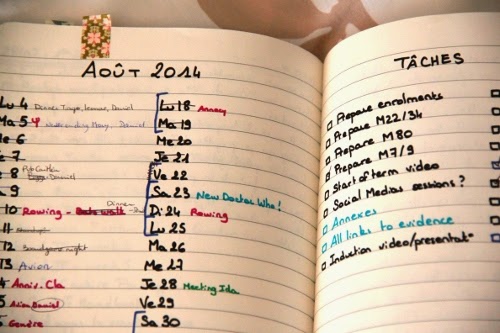
    One of the most important part in my journal are the weekly lists that I update every Monday when I arrive at the office. On a double page, I write down on one side my professional to-do list and on the other my personal one.
    For my pro one, I use the technique of the Bullet Journal.
    I tried their index system but quickly gave up: I just don't have enough pages about particular themes for it to be worthwhile. I might try and use this technique instead, that I learned about through @LibGoddess and @alkegw. It's simple and elegant. But for now, I use bookmarks made of masking tape. It's pretty and I don't have to number all of the pages anymore.

    Masking tape bookmarks in one of my last notebooks.
    The monthly calendar is not that useful to me either, since I'd rather use my Google Calendar and other paper stuff, but I really like the idea of the monthly to-do list, in order to highlight the big projects coming up.

    Calendar and to-do list for August.
    So one of the only things I've really kept is the "Bullet List" technique of the Bullet Journal. You do circles for meetings, squares for to-do items and sub-lists when there are several things to accomplish for one single project. I used to add colours by theme (Chartership stuff in light blue, training sessions in green...) but now I use colours to highlight urgent stuff instead (see below). And I use different types of pens to distinguish my professional lists (in felt pen) from my personal lists (in ball point).

    My To-Do Lists from last week.

    Finally, to decide on the priority level of tasks in my list, I use this technique: the idea is, instead of doing the easiest or least unpleasant first, to go through your to-do list by following this model:

    To adapt this model to your own job, replace "training" by your main mission.
    I do first things that would go in the area #1: those who will have the most impact on my training with minimal effort. Then I go to area #2 (high impact but lots of effort), #3 (low impact and low effort: those are often the most amusing tasks) and finally #4 (low impact, lots of effort).
    Sometimes, I highlight my priority tasks with little stars in front of the bullet. Just because. And sometimes, I do low importance tasks before higher impact ones, because I'm just human and nobody's perfect. And it's much funnier to update the library's Twitter rather than running after unwilling tutors who don't want their students to be trained on EndNote.

    The right journal

    Last, I wanted to say a few words about choosing the right journal. I began with Moleskines, which are beautiful and practical but so damn expensive. So I moved up to random ugly notebooks that I found for free. But ugly doesn't do it for me. I want beautiful objects to write in. Beautiful and cheap. So, when my relatives aren't giving me beautiful journals (like the one at the top of this post), I try to diy my precious notebooks. I just buy a £2 notebook from Sainsbury or wherever and I cover it with beautiful paper from Paperchase and lots of glue.

    One of my latest journals, hand covered an all pretty!
    I'll keep doing it for my next journals except that I think that I'm going to move to 100 pages notebooks (instead of 200) so as to make my handbag a little lighter...

    Monday, 13 October 2014

    Library anxiety

    This post is a translation from Thomas Chaimbault's post in French, "L'angoisse de la bibliothèque". His blog, Vagabondages, is an essential one in the French libraries' blogosphere. He writes about libraries and information sciences, mostly from an Higher Education point of view (he is in charge for information skills training in an Higher Education setting, in Lyon). If you can read enough French, I definitely recommend to add his blog to your reader and to follow him on Twitter!


    In 1986, Constance A. Mellon formalized the concept of library anxiety.

    This anxiety is supposed to be concerning quite an important number of readers, to various degrees, and would refer to both an anxiety of the library as a place (in its size, its fitting, its organisation and the classification of its documents) often considered as unclear, and of the library as a mean to find resources (services, resources, training...). It's a strong psychological barrier keeping students from using the library in an efficient manner, on site and online.

    The Anxiety of Searching for a Book, UCLA

    1. Theorizing Library Anxiety

    In her grounding article (which at least, formalized the concept, since other studies had already showed some apprehension of the public), "Library Anxiety: A Grounded Theory and Its Development", published in College and Research Libraries in March 1986, Constance A. Mellon describes a study carried out over two years about the students' feelings when beginning a library search. The results are clear: 75% to 85% of students mention a feeling of fear when using the library for the first time and this feeling is even more present when the time comes to do a search. An analysis of personal writings of students allows her to also identify recurring themes of fear, confusion, of being of out of their depth, lost, without resource, still at that fateful moment of the information search. It's by connecting those anxiety feelings linked to maths or tests that she coins this notion of "library anxiety".

    This anxiety can be translated in several ways:
    • Fear of the library as a place, often described by its impressive size;
    • Not knowing where to find information, nor how it's organised;
    • Lack of self-confidence concerning how to conduct a search;
    • Fear of the librarian him/herself with a refusal of asking for help;
    • Feeling like they're the only one not to understand how the library works;
    • Feeling of paralysis when starting an information search.

    From there, students seem less focused on their work and can't do their searches correctly. Mellon specifies: "Students become so anxious about having to gather information in a library for their research papers that they are unable to approach the problem logically or effectively". It can even result, according to the research of our American colleagues on this topic, in the failure of obtaining a diploma (Onwuegbuzie and Jiao, 1998).

    Without going that far, other researchers have shown since then the permanence of this negative feeling towards libraries (Bostick, 1993), while Jiao, Onwuegbuzie and Lichtenstein fleshed out the concept, explaining that those feelings could have cognitive, affective, physiological and behavioural consequences directly interfering with the carrying out of informational tasks (Jiao, Onwuegbuzie and Lichtenstein, 1996).
    This anxiety is considered as a unique phenomenon, specific to the library environment and not in connection with the general anxiety linked to the first years of higher education. Even though it has been suggested that some of its dimensions, like asking for help, can be linked to character traits independent from libraries, no empirical proof has been provided to support this proposition.

    2. A measurement scale

    In 1992, Sharon Bostick proposes a measurement scale to detect and evaluate the potential anxiety caused by the library on students. This scale identifies several areas carrying anxiety:
    • Barriers with staff: staff members are perceived as intimidating, inaccessible and anyway too busy or having other more important tasks to do rather than helping readers;
    • Affective barriers (perceived informational skills): the student feels incapable of doing searches and of using the library as a place for resources, this feeling being reinforced by the idea of being the only one to be lost and confused;
    • Being comfortable within the library (as a physical space): a feeling of comfort, security, of being welcome in the library, also linked to the layout and furnitures favouring or not how students are welcomed in the library;
    • Knowledge of the library (internal organisation): the student doesn't understand how the library is organised, doesn't feel familiar with it, feels frustrated;
    • Mechanical barriers: feeling linked to the machines, equipments, computers... A student having a hard time using machines is susceptible of developing a deeper anxiety.
    [download the Bostick scale]

    In 1997, Owuegbuzie adds:

    • Resources anxiety: frustration related to the resources availability, especially linked to not finding full-text during an online search.
    Several research studies have then focused on this anxiety's origin, trying to detect direct or indirect antecedents. If no direct antecedent was revealed, several indirect antecedents were then proposed, with situational, contextual or dispositional (that the student brings herself) origins.

    Source: Library Anxiety: Theory, Research, and Application by Anthony J: Onzuegubzie, Qun G. Jiao, Sharon L. Bostick

    Among those variables, Jiao and Onwuegbuzie mainly identified:
    • Low level of perceived social acceptance;
    • Social injonction for perfection;
    • Academic procrastination;
    • Bad study habits;
    • Low reading skills;
    • Learning style;
    • Low computer literacy;
    • Low hopes to overcome hurdles linked to goals' pursuit;
    • Social interdependence.
    Some of those research studies identify a complex link between this library anxiety and other anxieties linked to higher education, research, public communication; a whole set affecting the student more or less directly.

    Source : Library Anxiety: Theory, Research, and Applications by Anthony J. Onwuegbuzie, Qun G. Jiao, Sharon L. Bostick

    3. Fighting against library anxiety

    Studies trying to reduce library anxiety focus on how to make the library more acceptable, comfortable for students by giving them either the skills to develop their knowledge of the space and self-confidence, or to reassure them concerning the normalcy of the phenomenon and explaining strategies to use so as to overcome its negative effects.

    The idea is to work on the training provided, regarding its content as well as the librarian's attitude. Indeed, better trained students will feel more familiar with the space and will see their anxiety limited. More broadly, it means making it easier to meet professionals, getting students to understand and know that there will always be someone to welcome them, answer their questions without judging them and supporting them in their searches.

    Simply recognizing such an anxiety helps reducing it. Thus, several proposals have been drawn up:
    • Recounting this feeling or similar experiences with more or less humour through videos or discussion sessions between students;
    • Telling students that bad experiences at various levels of information search are normal;
    • Talking about this kind of anxiety during training sessions.
    But generally, the idea will be to get the library to become a friendly space, turned towards its users, to work on librarians behaviours, to provide a positive experience of the library as a space and to reinforce training sessions. So nothing extraordinary.

    Several libraries actively work on the topic and don't hesitate to follow up on students who could be victims of this anxiety. For example, the Washington State University's library proposes a specific libguide giving leads on how to apprehend the library better or playing on the librarian's stereotypes.

    Actually, we're doing the same and are also working through digital mediation to improve the user's experience, and thus to reduce this anxiety linked to the library. It goes without saying. But it's better to say it anyway.


    To go further: